A construction yard is the most beautiful thing there is
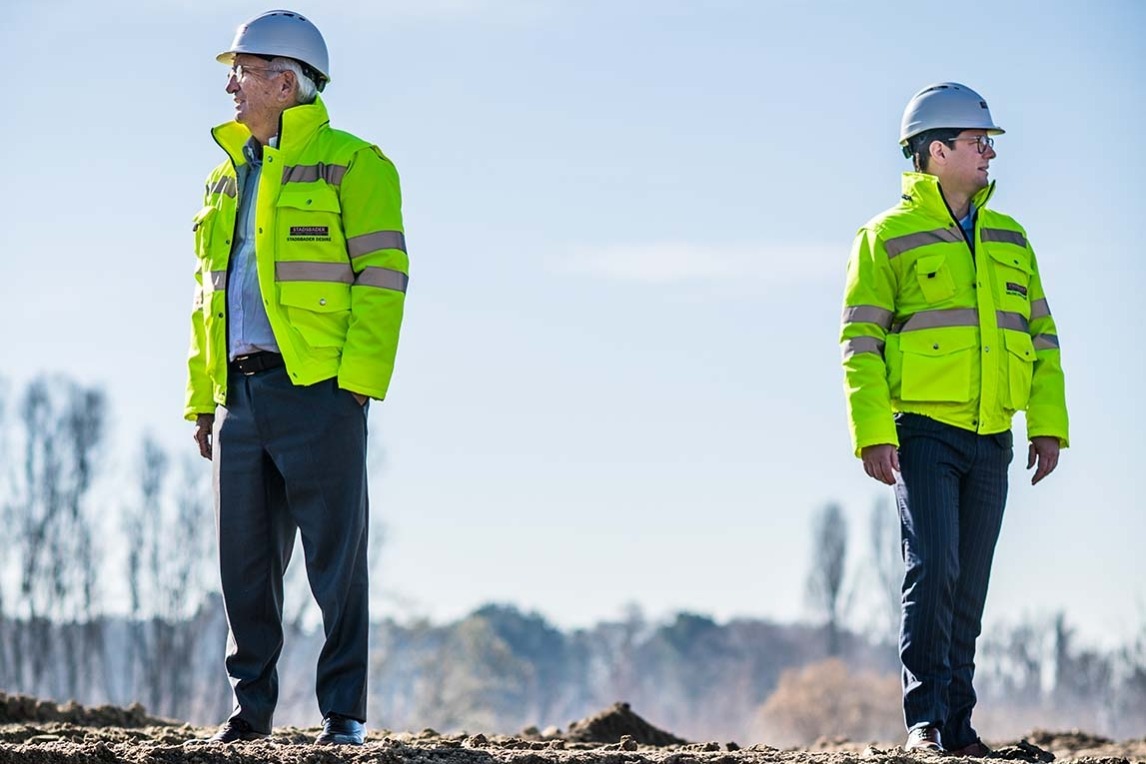
The West Flanders construction group Stadsbader is the big winner of the Oosterweel project on the Linkeroever. Father of the family, Desire Stadsbader and his stepson Dominique Valcke talk openly about their family business for the first time.
One million cubic meters. That much extra land is needed to build a brand-new road infrastructure on Antwerp's Linkeroever. It is the first giant construction site of the Oosterweel project, which was awarded for 386 million euros to the Rinkoniën consortium, of which Stadsbader is the major winner. The family construction company from Harelbeke, employing more than 1,000 people, is taking on more than half of the multimillion-euro contract involving all road works and associated electromechanics. "A boost for us and the entire road construction industry," says Desire Stadsbader, the 71-year-old president and founder who recently passed control over to his stepson, CEO Dominique Valcke (46).
We meet both contractors at the construction site near the Antwerp E17, where Stadsbader trucks are driving back and forth. 'Soon a whole village of those containers will rise up across the street,' Valcke says. This project alone requires us to hire around 100 people."
Stadsbader have bucked the economic trend like no other in recent years. While comparable road builders gave up their independence and sold out, the family-owned group chose to grow under its own steam. "Since 2015, our sales have increased an average of 25 percent annually."
You were not outdone by big foreign players in the European tender for the Oosterweel project. Why is that?
Desire Stadsbader: ‘Do not underestimate the fact that Belgium is a very competitive market. Only one French group competed, Bouygues, and they only came third, with a very high price. The bar was set by Belgian companies.'
Valcke: 'This is a project located in the middle of our market. We just couldn't afford to not be there. There are still great projects to tackle. The ring around Brussels, for example, but also the R4 around Ghent.'
You are not looking abroad yet?
Valcke: 'Our construction department is already working for Belgian Guido Dumarey's industrial group Punch in Strasbourg. That's 550 kilometres away. We also have a big presence in northern France. We don't refuse projects abroad, but fortunately there is still a lot of work on the home market
However, Stadsbader was very active abroad in the 1970s, notably with extensive works in Saudi Arabia.
Stadsbader: "That's true. My father, Desire Stadsbader senior, started out in 1946 as a supplier of building materials. He then experienced golden times as a road builder, building the E17 and E40 highways in Belgium. In the late 1970s, that boom came to an end.
'Through trade missions we ended up in Saudi Arabia, where we won major contracts such as the construction of the Dharaan military airport and the construction of the ring around the capital Riyadh. We eventually ceased operating there because of the first Gulf War.
Your father, who died in 2007, then decided to split up the group and divide it among his five children. Why?
Stadsbader: 'In Belgium at the time, we were mainly in a replacement market. We had to invest heavily in the company again, after ten years of winning projects mainly abroad. That split was just pure necessity. I continued with Stadsbader’s road construction activities, my brother Jean-Pierre became active in public works with the company TRBA, my other brother Jacques developed the building materials group Cantillana and my two sisters focused on real estate and project development. For very large projects, we work together
Have you ever regretted that split? If you had stayed together, Stadsbader might have been a giant no one could compete with.
Stadsbader: 'Well, it is what it is. You can't reverse that. There were business lines then that were very profitable at the time, but we sold those to finance the others. We had to make choices, and that split allowed us to stay on friendly terms. I still play golf with my brother Jacques every week, and I would like to keep it that way. I also see my other brother often."
How did Dominique Valcke join the company?
Stadsbader: 'He is my wife's son. I raised him. That creates a special bond. I have two other children from my first marriage, but they are not active in the business
Valcke: 'I had been walking around the company grounds since I was eight years old. You could say that I gained an interest in road construction from an early age. When I was twelve, I was sitting on the cooler box at four in the morning waiting to ride along to a construction site. Participating in a construction site, it doesn’t get better than that. You get to see how a project is delivered, step by step.
How active are you still, Mr. Stadsbader?
Stadsbader: 'I am still chairman of the board, and I am involved in some projects. But I'm seriously winding that down
Has the transfer already been finalized?
Valcke: 'It has been a pretty straightforward process. In 1997, I became a manager in the company and from there we carried out a management buyout in stages until the process was completed in 2013. We continued to operate as a duo all these years, continuously sharing files. There were no abrupt transitions.'
Who is principal shareholder of Stadsbader?
Stadsbader: "Dominique. Everything has been completed. I left the capital. I only chair the board of directors anymore
That board is very limited though.
Stadsbader: "Yes? How many are we?
Valcke: 'Well, the two of us (both laughing). ING banker Luc Vandewalle sits on our advisory board.'
Why such a closed club?
Valcke: 'Short lines and quick decision-making.'
Stadsbader: "Maybe in time we will expand the board."
Valcke: 'We organise regular strategic get-togethers with members of management, where all crucial topics are thoroughly discussed. But I admit, a group of this size with barely two board members is an exception
Stadsbader: "There are still family businesses that operate this way, but not many."
Where does Stadsbader want to be in five years?
Valcke: (thinking) "We want to remain a family business. There is no doubt about that.
Stadsbader: 'His son Quentin is coming up. He's turning twenty."
Valcke: 'If later on it turns out that working in tandem with my son is not possible, then the model will have to be adjusted.'
Is Oosterweel the dawning of another golden age for road construction?
Stadsbader: "No, this project was promised to the market 12 years ago. It is not the swallow that makes a spring.'
Valcke: 'Infrastructure investments in Belgium are almost half that of neighbouring countries. Government efforts have been underwhelming since the 1980s. Catching up is definitely necessary
Stadsbader: 'N-VA, Open VLD and CD&V are all willing to increase those investments. The Greens also want money for De Lijn and public transportation. But whether all this signals a new golden age? We’ll have to wait and see.
Does enough cash remain for a strategic acquisition?
Stadsbader: 'We acquired Deckx in 2009 and Van Maercke in 2014. We have reserves of 105 million euros and five years have now passed.
I believe that it is time for a new acquisition.
Stadsbader: (laughs) It could be, but the opportunity has to present itself.'
Valcke: Anything related to construction projects that can add value and continuity to our company should be investigated.
Stadsbader: 'We have little or no financial debts. Growth is necessary, but as things stand, whoever wants more market share will have to take it away from someone else.'
Source: De Tijd